Friday, 21 April 2017

ORATORIAN COMMUNITY IN FORMATION - SECOND SUNDAY OF EASTER 2017


There never was an event in the whole of history like the Resurrection of Jesus Christ. It was the trigger for an explosion that echoes throughout the world to this day. It fulfilled the promises God had made long before to a tiny nation called Israel, turning their faith into a world religion. The faith to which it gave birth, Christianity, has sent out missionaries, from the first apostles to the present day, to proclaim the Good News throughout the earth, most often at great cost and suffering, all of which, in his name, have been accepted joyfully. It has been the power through which civilizations have risen, through which empires have been laid waste. It has been the focus, throughout the ages, of ongoing hostility and attack, often bringing it low, but from which it has always risen again. More even than those of the Big Bang, its repercussions surround us still, and the hedonistic and secular world in which we live has been powerless to still it. The consequences of that empty Easter Sunday tomb haunt us still.

Why should this event, by world secular standards so insignificant, have had so tremendous an effect? It begins with the very evident facts of suffering, sorrow, sickness, pain, toil and above all, death. Human beings have tried to make sense of these things for millennia. Our in-built sense of justice rejects them as wrong. There have been many proposed solutions to this problem, none of them of any lasting significance.

Israel, from whom our faith comes, saw the problem as the disconnection of human beings from their Creator, an event so dramatically represented by the tale of Adam and Eve in the garden. Man, made, as the Hebrew anthropology would have it, of the dust of the earth and the breath of God, becomes a living being. Rejecting his unity with God, wanting to become like God, he forfeits that divine life, and becomes mortal, “returning to the dust from which he came,” with all the sad consequences with which we are already familiar.

God, however, out of love, even for his aberrant creation, has a plan for us. Central to this plan are two essential elements: a Covenant he has made with his people, and a mysterious figure called the Messiah, the Anointed One, who will finally redeem mankind from sin, suffering and death. Israel worshipped their God, not just as the God of Israel, but as “King over all the earth.” They foresaw a time when all nations would come to know the true God through Israel, a “light to the nations,” when Jerusalem would become the capital and religious centre of the whole world.
The key to this was that mysterious figure, the Messiah. 

He was originally a king, a successor of David, who would sit on David’s throne for ever. As their kings fell into disrepute, and their kingdom was divided, the Messiah deepened into a figure proclaimed by their prophets, a figure who, like the prophets themselves, became a Suffering Servant of God, on whom “lies a punishment that brings us peace.” Finally, as their kingdom was destroyed, living in exile, they understood that their only hope lay in a direct intervention of God from heaven itself, as the prophet Daniel would have it: “I gazed into the visions of the night, and saw, coming on the clouds, one like a Son of Man.”

Then came Jesus. For a time, he seemed to fit the profile of the Messiah. His teaching cut across the casuistry of the Jewish leaders, for he “spoke with authority.” His miracles certainly made a tremendous impression on his contemporaries. The hope of many in Israel, after centuries of depression and oppression, was fixed on him. True, he said some strange things, like his claims to divinity or his prophecies of suffering and death, but at the time, these were rather glossed over.

Then came disaster. He was arrested, tortured and crucified. His death was regarded as a cursed death, which put the nail in the coffin of all his followers’ expectations. It was the end of everything they had dreamed of, and made a mockery of their hopes that the fullness of time had come, that Jesus of Nazareth was to be the Messianic fulfillment of all God’s promises to Israel.

Then, the unbelievable happened. An empty tomb, rumours of strange events. Then the shattering reality as he actually appeared before his disciples, showing himself to have risen from the dead. In a flash, it all became clear to them. All those prophecies about suffering were real and literal! He really had risen from the dead! Jesus, descended from the house of David, the Suffering Servant, the Son Of God sent by the Father, really was the Messiah! All that God had promised to Israel in the pages of the Old Testament, really had been fulfilled in Jesus, but in a way they could never possibly have imagined.

But most of all, His death really had destroyed death. For the Jews, death was the climax to sin and suffering. If it was destroyed, so were all the others. If Jesus had really died and risen – and on the evidence of the gospels, there can be little doubt of this – then death was no longer the ultimate reality. There was real hope for the world, since at last, all that was wrong with it, could be set right.

After that, it was unstoppable. It spread through Israel, the Middle East, the Roman Empire, the world. It is spreading still. Its message is simple: in Jesus’ own words, “He is risen! He is Lord! He has ascended! he will come again! Repent and believe in the Good News!” The key to this Good News in a nutshell is “He is Risen!”

We are the heirs to his promise. And through faith in Jesus Christ, in submitting our lives to his will – which always wants only the best for us – we are called to share in that promise. In the Resurrection of Jesus Christ, death is no more than a passage to indestructible, eternal life with him.
In the simplest command he ever gave us, “follow me,” lies our hope of salvation. He has gone before us to prepare a place for us. He loves us and wants us to follow him. He is our Way, our Truth, our Life, the only path to the Father in heaven. In this world, we may still have sorrows, but he calls upon us to stand firm; by dying and rising from the dead, he has already conquered the world. He is our Resurrection and our Life. Let us worship him and praise him, for he is our only hope. "The Lord has truly Risen. Alleluia! Alleluia!"

ORATORIAN COMMUNITY IN FORMATION - EASTER SUNDAY 2017


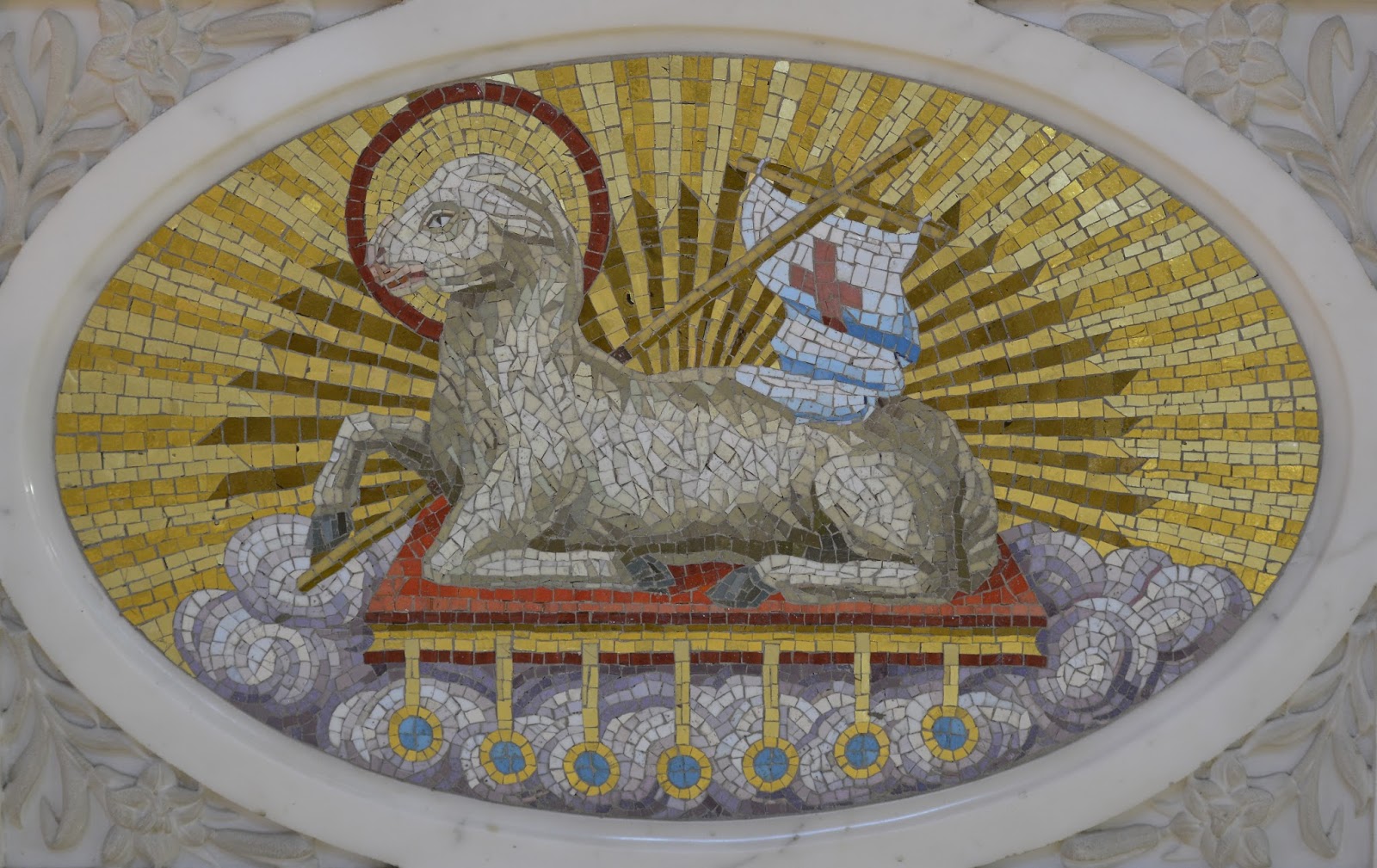
One of the most dramatic images of the Risen Jesus in the New Testament is to be found in the heavenly assembly in the Book of Revelation – also known as the Apocalypse of John. In it, John describes the risen Jesus as follows: “Then I saw a Lamb, looking as if it had been slain, standing at the centre of the throne, encircled by the four living creatures and the elders. The Lamb had seven horns and seven eyes, which are the seven spirits of God sent out into all the earth.” (Rev. 5,6). It is a striking, even terrifying image. The woolly lamb is, in our imagination, the weakest and most helplessly gentle of creatures. Yet here it becomes a divine creature with the fullness of power – seven horns – and the all-seeing vision of God – seven eyes.

Almost all of us would pass over the word “standing” as merely describing the Lamb’s physical position. Yet it is, perhaps, the most important word in the verse. In Greek, the word is hest­ekos, which comes from another Greek word, anhistemi, which means to “rise up.” In other words, the Lamb “standing” means the resurrected Lamb, and standing “as if it had been slain” is the crucified and resurrected Jesus, the “Lamb of God who takes away the sins of the world.” The Afrikaans word “opstanding” translates it perfectly.

It is impossible to exaggerate the importance of the Resurrection of Jesus, because it is simply, without qualification or rival, the most important event in history. Resurrection is a Jewish idea, the basis for which we first encounter in the Bible as early as Genesis 2,7: “Then the Lord God formed a man from the dust of the ground and breathed into his nostrils the breath of life, and the man became a living being”. For a Hebrew, we are formed from those two most fragile of things; dust and breath. And yet, in this image, it is the breath, the Spirit, of God that gives us life. When God takes back his Spirit, life leaves us and we return “to the dust from which we came.” It is easy to see from where this imagery comes.

In other words, for the Hebrews, man is not a spirit trapped is a body; he is a living body. We are dependent upon God for our very existence. And for this reason, eternal life is impossible without a body. Therefore, without a resurrection, there can be no eternal life. And for a Christian, the Resurrection of Jesus makes possible our own resurrection; if he has not risen from the dead, then we cannot rise from the dead, and there is nothing beyond death for us. Paul puts this all exquisitely in 1 Corinthians 15.

And so, during this season of the Church, there is an explosion of joy in the Resurrection. “He is risen! He is risen! He is risen!” For in the Resurrection of Jesus is all our hope, and it is our only hope. It is strange, is it not, that all our hope should be placed in an empty tomb? Yet this is exactly the basis of all our hopes, our longings, our desires. May God grant us a blessed and happy Easter, and may we all experience the life-giving power of his Resurrection in our lives.

Saturday, 8 April 2017

ORATORIAN COMMUNITY IN FORMATION: TIMES OF WORSHIP - HOLY WEEK 2017


PALM SUNDAY 13th April:             CATHEDRAL                                ST JOSEPH
                                                               Mass 7.15am, 9am, 6pm             Mass 10am
                                                               Confession 8.15am                      Confession 9.30am

MONDAY 14th:                                  Mass 9am                                       Mass 6.30am

TUESDAY 15th:                                 Mass 5.30pm/Stations                 Mass 6.30am

WEDNESDAY  16th:                         Mass 9am                                       Mass 6.30am

HOLY THURSDAY                          Mass of the Last Supper 7pm Cathedral & St Joseph's
                                                             St. Joseph's: Adoration and confession after Mass

GOOD FRIDAY                                Cathedral: Confession 10am-11.30am, 2pm-2.50pm, 
                                                            Stations of the Cross 10am
                                                             St Joseph's: Stations of the cross & confession 10am

                                                             Solemn Liturgy 3pm Cathedral & St Joseph's

EASTER SATURDAY                      Easter Vigil 7pm Cathedral & St Joseph's


EASTER SUNDAY:                          CATHEDRAL                                ST JOSEPH
                                                             Mass 7.15am, 9am                       Mass 10am
                                                             Confession 8.15am                      Confession 9.30am
                                                              PLEASE NOTE: NO 6PM MASS TODAY

ORATORIAN COMMUNITY IN FORMATION: PALM SUNDAY - 2017


After all the fasting, prayer and almsgiving of Lent; after forty days of denial, we come, at last, to the great saving events of Holy Week, with which Jesus ended his earthly life and mission. We see him proceeding triumphantly into Jerusalem. We see him disputing with the leaders of his people. He celebrates the Passover with his disciples. He washes their feet. He prays alone during his Agony in the garden. He is arrested, tried, scourged, crowned with thorns; and then crucified. He dies on the cross, and like any other human, is buried.

Jesus carried an immeasurable burden on his shoulders. He bore the weight of the sins of the world alone. But all through his earthly ministry, his suffering and death, his Father was close to him, and the Holy Spirit was present within him. The Holy Spirit sustains those who bear witness to Christ, frequently at the cost of their lives. They are called martyrs, and the word martyr means “witness”. All this is why we call this particular day Passion Sunday as well as Palm Sunday.

Passion comes from the Latin word for suffering. When we suffer things, they happen to us rather than being controlled by us. The Passion of Jesus was something that happened to him. He surrendered control of his life to the earthly powers who brought him to his suffering and death. He did this willingly, knowing that it was the will of his Father, that it was the only option for the human race that he should die, taking our sins on his shoulders. 

The Creed puts it like this: “He suffered under Pontius Pilate.” But we must recall that it was his choice, and the will of his Father: “You would have no power over me were it not given to you from above,” he tells the same Pontius Pilate. But Jesus does not allow earthly powers to triumph. He surrenders his life to them so that he may defeat them by rising from the dead. “God so loved the world that he gave his only-begotten Son, that whoso believeth in Him should not perish, but have everlasting life.”

There are times when earthly powers seem to triumph, when we appear powerless in the face of them, when we seem to have no choice but to yield to them. But we must never believe them to have the final say. Not only did Jesus have the ultimate victory over them by rising from the dead, but in the very act of defying God by killing his Son, these same earthly powers were actually carrying out God’s will. We can never grasp the fullness of God’s plan for his creation. But we can be assured of one thing: “He that doth endure to the end shall be saved,” as Paul expresses it. If we remain faithful to him despite all, we will share in his ultimate victory over sin and death.


Fr Phillip.

Friday, 31 March 2017

ORATORIAN COMMUNITY IN FORMATION: FIFTH SUNDAY OF LENT - 2017


Why is there suffering and evil in the world? Why is it necessary for us to die? Is death the end of all things? These are questions that must have been in the minds of Mary and Martha when their brother died. All human beings ask them at one time or another.
Jesus speaks of his own death in terms of a grain of wheat. Unless it falls to the ground and dies, he says, it remains a single grain. But if it falls and dies, it produces a rich harvest. It is a singular fact that a grain of wheat produces many times its own weight in growth; the wheat plant itself, and finally the harvest, where from one grain, many ears of wheat are the harvest.
In this simple example, Jesus shows how much power there is in his death. There is not one little grain left to rot in the ground. That grain which dies, bursts forth with life, a harvest out of all proportion to what it was before it was planted. Jesus’ death and resurrection brings forth that kind of life.
Jesus’ saying answers the very deep questions to which human beings seek answers. The “Why?” of suffering and death is beyond our understanding. Even Jesus, the Sinless One, had to suffer and die. We, who are sinners, must also die. But the answer of God in Jesus goes much further than a simple “Why?” For it shows that there is a meaning to suffering and death. Jesus’ suffering and death brings forth power and life. Like the grain of wheat, life is an inevitable consequence of Jesus’ death. That life is the destruction of evil. It is given to all who believe in His name.

Whether we are given eternal life or not, according to John, depends upon whether we believe or refuse to believe in Jesus, and thus in God who sent him. If we refuse to believe, he will respect our desire to be without Him for all eternity, and the power of His saving death and resurrection will do us no good at all. In believing, we choose the glory of Jesus, the life He promised to all who believe in his name. God does not merely explain the world to us; He changes it for us. All our suffering, all the evil we encounter, the death which is our lot, are given meaning. Because of the death and resurrection of Jesus, all these things are rendered powerless over us. Our own suffering and death become a path to light and eternal life, if only we believe in his name.


Fr Phillip.

Sunday, 26 March 2017

ORATORIAN COMMUNITY IN FORMATION: FOURTH SUNDAY OF LENT - 2017

The healing of the man born blind. Front, Jesus heals the man. Left, the Scribes and
Pharisees look on in disapproval. Right, the man washes his eyes and regains his sight.
Speaking of cruelty and evil, the great GK Chesterton once wrote: “If it be true (as it certainly is) that a man can feel exquisite happiness in skinning a cat, then the religious philosopher can only draw one of two deductions. He must either deny the existence of God, as all atheists do; or he must deny the present union between God and man, as all Christians do. The new theologians seem to think it a highly rationalistic solution to deny the cat.” (Orthodoxy) When one reads some of the ludicrous attacks on Christianity in social media such as Facebook, one cannot but be reminded of Chesterton’s amusing comment.
But this problem is much older than we think. We find it amongst the leaders of Jesus’ people in today’s gospel, in the healing of the man born blind. They do not want to face the implications of Jesus’ work, which would lead them into having to accept Jesus as what he claims to be; the Son of God. For them this is a blasphemy. As a result, they try to deny the existence of the miracle by undermining the evidence of its having happened.
The man who was healed and his parents are interrogated. The parents are too afraid to say too much, in case they are expelled from the synagogue. The man born blind sticks to the one indisputable fact: “I only know that I was blind, but now I see,” he says. When the Pharisees try to discredit Jesus, the man born blind laughs at them. “He opened my eyes, but you don’t know where he comes from!” In other words, Jesus’ actions prove him to be the Messiah. The leaders accuse Jesus of being a sinner for healing on the Sabbath. Since God does not listen to sinners, the healing could not have happened. They accuse the man born blind of being a sinner; being born blind means being born cursed by the Law, so that his evidence is inadmissible. In fact, far from investigating the miracle, they do everything in their power to AVOID doing so.
But the man born blind sees and believes. HE is drawn to recognise Jesus as the Messiah. Jesus, the Light of the World, has given him not only the light of vision, but also the light of faith. And Jesus applies this lesson to the leaders. They have vision, he says, but their refusal to accept an undeniable miracle and therefore accept Jesus for whom and what he is, makes them spiritually blind. And in that spiritual blindness, it is THEY, and not the man born blind, who are the real sinners.
How often are WE blind to the wonders that Jesus works among us, within us, because what he does and what he calls us to be, does not suit us? We must not cling to our own dark little vision of reality. We must invite Jesus to take away our spiritual blindness, so that we can recognise him as the Lord and see the world as He sees it; so that we may follow him wherever he leads us.

Fr Phillip.

Saturday, 18 March 2017

ORATORIAN COMMUNITY IN FORMATION - THIRD SUNDAY OF LENT - 2017

Model of the Jewish Temple at the time of Jesus.

“Destroy this Temple and in three days I will raise it up.” But he spoke of the temple of his body.
During the long period of time between the Exodus and the time the Jews entered their Promised Land Israel was, as in the days of Abraham their father in faith, a nomadic people. Its homes were tents. As it moved from place to place, the action of “pitching one’s tent” was a common one. In the midst of the camp of Israel was the biggest and most important tent of all, the “Tent of Meeting”, where the Ark of the Covenant was kept, and where the altar was raised for the purpose of offering sacrifice. The Tent of Meeting was the place where God made his presence specially known, the place where Israel went to seek counsel. If one sought to be especially close to God, it was to the Tent of Meeting that one made one’s way.

The tent became a symbol of human life itself. To unpitch one’s tent meant to die. To pitch one’s tent meant to be born, to take up residence, so to speak, in the community. Even after David the king had built himself a magnificent palace in Jerusalem, the Ark of God continued to be kept in a tent. The Temple, when first built in Jerusalem, was based upon the design of the Tent of Meeting. The nomadic image of a tent being put up and struck, also represented the transience of human life. It reminded Israel that human life was but a temporary thing, that our real life lay hidden with God.

This idea persisted into the New Testament. Paul, a former Jewish rabbi converted to Christianity, was by profession a tent-maker, and refers to the human body as a tent in 2 Corinthians, the passing flesh which will be replaced by a glorious body at the Resurrection. And the profoundest and most powerful reference to the human body in this way comes in the Prologue to the Gospel of John, words we know as, “And the Word became flesh and dwelt among us”, literally “he pitched his tent among us.” For we are a nomadic people on a journey to our Promised Land, to eternal life with God, and in this image Jesus, like us, took on flesh and became one of us. He not only lived amongst us; he became, in the fullest sense possible, one of us.

And now, Jesus’ words, “Destroy this Temple and in three days I will raise it up,” reveal their true meaning. Jesus the Son of God has, like the Tent of Meeting, pitched his tent amongst us. He has become present amongst us in the fullest sense, as one of us. He has become, amongst us, “veiled in flesh”, transient flesh that, like ours, must die, to be raised from the dead in glorious form. He has assumed to himself the very Temple of the Lord for, as he tells the woman at the well in Samaria in today’s gospel reading, the time is coming when we will worship him “in Spirit and truth”, that is, wherever his presence is to be found. His glorious body is to replace the Temple in Jerusalem.

The Greek word luo, which he uses when he speaks of destroying the Temple, is also the word used to describe the decaying of a body in the grave, ontbinding, as it translates so neatly into Afrikaans. But even here it says more than the English reveals. For the sense of the statement, “Destroy the Temple, and in three days I will rebuild it”, is not a statement, but a command. “Destroy this Temple!” he commands them, as though that is what they have been doing all along by turning it into a “den of thieves” with their crooked market. Destroy this Temple – it doesn’t matter. It is in my resurrection that it will be raised up, and the new Temple will be my Body.

This is a great warning and a promise to us. It is not the stone Temple of Israel that will be raised up, but the temple of glorious flesh that will be our resurrected bodies. Do we want to be raised to live with God for ever in glory? Because if so, we must live as though our very beings are a “house of prayer.” If we turn ourselves into a “den of thieves” through unrighteous living, through immorality, through abuse of substances, be they alcohol or drugs, through crooked dealings and dishonest living, then we can expect his righteous anger over us as well. We cannot turn ourselves as human beings into such a thing and still expect God to accept us as one of his own. 

“My house shall be called a house of prayer,” he says. In other words, we must allow him, through the power of his Spirit welling up within us, to make of each one of us a place where he is worshipped in Spirit and truth. We must become living stones in the building of his living Temple. Where two or three are gathered in his name, he must truly be present in us, in Spirit and in truth. Can we truly and honestly say that each one of us is serving him like this? If not, it is time for us to make some major changes in the way in which we live.

Saturday, 11 March 2017

ORATORIAN COMMUNITY IN FORMATION: SECOND SUNDAY OF LENT - 2017

In this icon of the Transfiguration Jesus, transfigured and shining like the sun, is seen speaking with Elijah on his right and Moses on his left. In the foreground are Peter, James and John. To the left of the icon, Jesus leads his disciples up the mountain before the event and right, He warns them as they descend, to tell no-one that He is the Messiah.
In last Sunday’s gospel reading the devil, having tempted Jesus and failed, “left Him, to return at the appointed time”. In today’s gospel, the disciples are warned to say nothing of the Lord’s Transfiguration “until the Son of Man has risen from the dead.” These are two of the many places in the story of Jesus in which time plays an important role. Not time in the sense of the days, hours, months and years by which we measure the passing of our lives. Time here means the right or wrong moment, what we might today refer to as the “timing” of an event. This kind of time only makes sense if there is a plan behind it, for how, otherwise can timing be right or wrong? In Jesus’ case, the plan is God’s one for his whole creation.
In his letter to the Galatians, Paul says, “When the fullness of time had come, God sent His Son, born of a woman.” This means not only that Jesus’ birth occurs at the right time, but also that it is so important that all other events are meaningless next to it, or that they acquire their meaning from this event. And in John’s Gospel, the Hour of Jesus is equally important; for it refers to the even more important event of His saving death. At the Last Supper Jesus says, as Judas leaves to betray him “Now the Hour has come for the Son of Man to be glorified.” Jesus’ “Hour” happens in the swift and violent action of His last few days on earth.
One of the most striking of these is revealed by comparing Jesus’ Temptation with the Way of the Cross. At the beginning of his public ministry, Jesus is tempted three times by the devil, and three times the devil is rebuffed by Him. The devil goes away, to return at the appointed time. The appointed time, his “Hour” is, of course, that of Jesus’ suffering and death, the time of the reign of darkness, and also of its destruction. Jesus did not fall before the tempter in the desert, but He falls three times on the road to Calvary. But Jesus is not giving in to sin; He is staggering under its unbearable load as He fulfils his destiny to be “the Lamb of God who takes away the sins of the world.”
Jesus himself is the ultimate fulfillment of God’s Plan for us, when the fullness of time had come. In Jesus, God’s meets us at the crossroads and calls us to follow Him down the path He has taken. But we need to remember that His path crosses ours, for the paths we map out for ourselves are rarely the paths he follows. When we meet Him at the crossroads, His invitation is always the same: “Follow me.” These are the “times” in our life; these are the “hours” when we, too, are called on to make crucial decisions, decisions which cannot be delayed: to follow Him, or go our own way.

Crossings converge and then diverge; the longer we wait, the further away from us he moves. “Yes, Lord, I’ll follow you, but not just yet” is not an adequate answer, for by the time we are ready for Him, we may no longer be able to find Him. When His path crosses ours, it is a “now” moment. At such moments, Jesus requires an immediate answer, and we need to find the faith and courage to follow Him wherever he leads us. 

Saturday, 4 March 2017

ORATORIAN COMMUNITY IN FORMATION: FIRST SUNDAY OF LENT - 2017


Every year, on the First Sunday of Lent, the gospel of the temptations is read. Mark’s gospel is the shortest, telling us briefly that Jesus was in the desert for forty days being tempted by the devil. Luke and Matthew, from whose gospel we read today, tell a more detailed account. In both, the devil appears to Jesus in what appears to be material form, and presents him with three temptations. In each, the devil tries to convince Jesus by quoting scripture to Him. In each case, Jesus rebuts the devil with his own quotations from scripture.
What is the meaning of these temptations for us? One very important point is that Satan does not always tempt us with a stark choice between good and evil. In fact, this rarely occurs. He is more likely to tempt us to what may seem little compromises of our faith, then to lead us progressively further away from the truth in little steps that seem almost harmless in themselves, but which mount up and gradually increase our distance from God, until we have lost sight of Him. Satan does not particularly want us to become mass murderers or armed robbers or spectacularly evil people; in fact, this might blow his cover. Anything will do for him, no matter how small, so long as it separates us from God, and little step by little step will suit his purposes just as well as dramatic breaks with God, as long as he can draw us progressively away from Him. In fact, this suits him better; the less his work in separating us from God is noticed, the more chance he has of succeeding.
He tempts Jesus like this. To compromise His powers to feed himself, that is, to use them for his own comfort rather than the purpose for which God has given him. To perform a spectacular feat of power by jumping off the Temple wall and letting the angels save him; in other words, to take a superficial short cut to winning people to God. To be given the whole world for one small act of worship, for Satan is the Prince of the world; as King Lear puts it, what if one could gain the whole world for one small sin? But Jesus knows that even the smallest act of worship of Satan is a betrayal of God, and a deadly one, and refuses point blank.
The gospel shows us that scripture can be misused; the devil can quote the Bible with the best of them. But he abuses it for the purposes of damnation, whereas Scripture is for our salvation. But most of all, it shows us how dangerous are even the smallest compromises of God’s truth: “Man does not live by bread alone…you shall not tempt the Lord your God…worship the Lord your God alone.” This Lent, let us search our hearts for all the small (and large) compromises we make with God’s truth, and let us come back to Him and serve Him, and Him alone.

Fr Phillip.

Tuesday, 28 February 2017

ASH WEDNESDAY MASS TIMES - 1ST MARCH, 2017


Ash Wednesday Mass times are as follows:

St Joseph's, Bloemfontein:
            6.30am

Sacred Heart Cathedral, Bloemfontein:
            9am (Archbishop celebrates)
            5.30pm

Sunday, 26 February 2017

ORATORIAN COMMUNITY IN FORMATION: EIGHTH SUNDAY OF THE YEAR 2017


The world loves to speak of love. We all know the old cliché “It’s love that makes the world go round”. But by “love,” the modern world really means “sex” and all the short-lived, superficial passions that accompany it. This certainly does not mean that sex is bad, or superficial, or undesirable. To the contrary, it is part of the order in this world created by God, and of everything that he created, “God saw that it was good…and indeed, it was very good.” But the modern world has divorced sex from the God who created it, and in doing so has separated it from the elevated and profound purpose which God destined as its end. In cutting mankind off from God who is love and the source of all our love, modern secular society has come to equate sex with love.

                You do not have to look very far to see this. Switch on your TV in the evening, or glance briefly at the magazine covers in the local supermarket. You could also try the Divorce Court rolls in the newspapers. The high rate of divorce on the grounds of infidelity proves that a large proportion of human beings still believes in mutual fidelity, but that lifelong mutual fidelity isn’t working. Why? Because we are no longer able to rely upon the enduring Love of God, we have been forced to make do with that feeble emotion we humans call love. Christians need to ponder the limitless mystery of God’s love, for it is the very reason why we were created, why we continue to exist, and why there is still hope for us all, and a reason for us to soldier on despite the negativity we see around us every day.

If you ever wondered what was wrong with the world, think of that figure on the cross, selfless, dying to set us free, giving us a love that rescues us from our ugliness and hatefulness – yes, even the young, beautiful and rich – and makes us beautiful and lovable. Think of that image; and then look at the world around you. God never meant us to live like this – struggling to survive on our own shallow passions. He always willed us to live in his love, and he wills us to do so still.

Do you think there is even a choice as to what sort of love, human or divine, the world needs? what sort of love is our only hope? For it is the one hope to which we might cling, the only certainty which will never fail. Let us choose that hope today. Let us welcome into our lives the everlasting hope and salvation offered only by the Love of God. In a word, let us submit our lives, our hope our all, to the God of Love.

Fr Phillip

Friday, 17 February 2017

ORATORIAN COMMUNITY IN FORMATION: PROF. JOHAN ROUSSOUW ADDRESSES THE NEWMAN ASSOCIATION

The Bloemfontein Newman Association held its opening meeting on Tuesday, 14th January, 2017. Our first speaker for the year was Prof. Johan Roussouw of the University of the Free State, a member of the Orthodox Church, who delivered a moving lecture on Orthodox Spirituality. This is one of Prof. Roussouw's many areas of expertise. He clarified a number of areas of misunderstanding that are held about the Orthodox Church, and proceeded to explain its deep and rich traditions of prayer and meditation, as well as the central importance of its Liturgy in that tradition. The almost forty people who attended were deeply impressed by what they heard, and many questions were asked at the end, all superbly fielded and answered. Fr George, the Orthodox priest in Bloemfontein, was happily present on this occasion.

The Newman Association meets again on 14th March, when Dennis Molyneaux, attorney-at-law, will be speaking on the death penalty. Those wishing to attend are welcome. Please call Mrs Paddy Huygen, the Cathedral Secretary, at 051-447-2827 in order to have your name added to March's guest list.

Below are a few photographs of last Tuesday's Newman Association meeting.


Dinner draws to an end, and the guests move through to the lecture venue.

From left to right: Prof. Roussouw, Fr Johnson,
Fr George (Orthodox Church) and Mary Paine.


Prof Roussouw addresses the Newman Association.

Some of the people who attended the Newman Association on 14th February. A cell-phone camera is, frustratingly, never quite wide-angled enough to take in the entire scene!

ORATORIAN COMMUNITY IN FORMATION: SEVENTH SUNDAY OF THE YEAR - 2017


Last Sunday our attention was focussed on the Jewish Law in the Old Testament reading. Law in itself, we learned, is not enough to keep us close to God. We need something outside the Law to make it work. That is why the New Law which the prophets foretold, the Law of Jesus Christ, is “written on our hearts” (Jeremiah 31,31). In the Old Testament this extra something is called the Law of Holiness: “Be holy, for I, the Lord your God, am holy.”

The journey to God is centred upon this: the Quest for Holiness. It is the most important quest of our life. To be holy, to be without sin, like Jesus, is what makes us fit to live with God for all eternity. We cannot do this by ourselves; it has to be done by God, through the death and Resurrection of his Son, the Lord Jesus. When we turn to God and ask him to forgive our sins, he answers through the power of the Holy Spirit at work in our hearts.

But we cannot become holy by worshipping God on our own; there is no such thing as a private Christianity. God calls us to be part of his community, the Church. Of course we must pray and read the scriptures privately. But we also pray with our families. And we worship God with the whole Church community on the Lord’s Day, and receive, from the hands of his ministers, his Body and Blood, which the priest has made present upon his altar. We confess our sins and receive God’s forgiveness through the absolution of his priest. We take part in the life of the Church, and through our generosity assist and engage in its many ministries and outreaches.

To become holy, we must also bear witness to Jesus Christ our Saviour to the unbelieving world around us. We can do this by word and good action. But we can also do harm to Jesus’ mission by bad example and behaviour. We can harm both ourselves and the Church’s mission by denying our faith in Jesus Christ when we most need to affirm it before other humans.

Loving and serving Jesus is our path to holiness. He is the Law of the Lord which makes us holy. “For there is no other name in heaven or on earth by which we can be saved,” as Peter himself puts it (Acts 2). It is through loving and worshipping Him, through serving Him in his Church, through bearing witness to him in the world, especially amongst those who are in most need of our help, that we are made fit to live eternally with God. The path to God lies open before us. Let us set out upon it without delay.

Fr Phillip.

Saturday, 11 February 2017

ORATORIAN COMMUNITY IN FORMATION: SIXTH SUNDAY OF THE YEAR - 2017


We have all, in one way or another, had something to do with the law. Especially in civil law, where the penalties are money or property, matters generally boil down to a simple issue; what is the minimum I can get away with? Whether it be maintenance in a marriage case or compensation for damages, the defendant will try to argue down the amount due, using all the evidence at his or her disposal. Watch one episode of Judge Judy and this will become abundantly clear.

Law is aimed at regulating just relationships between people. It is a necessary part of a well-ordered, functioning society. But it has two serious shortcomings; it sets the terms for the minimum required, and it does nothing to promote reconciliation and love; rather, it tends to accentuate differences and even increase bitterness. Law requires something outside itself to achieve true healing between those involved in its process.

When God gave Israel its Law, he intended it to be a means of regulating relationship between Israel and Himself. With it came a very special requirement that was to govern all the Law’s other commandments; the Law of Holiness. “Be holy, for I, the Lord your God, am holy.” But ultimately, a Law written on tablets of stone seemed to produce hearts of stone (Ezekiel 36). Both Ezekiel and Jeremiah (31,31) foresaw a new law written in the very heart of man. This law was an living, personal relationship with Jesus Christ, which fulfils and exceeds all other laws. It is the perfect fulfilment of the Great Commandment: “Love the Lord, your God, with all your heart and with all your strength and with all your might…and your neighbour as yourself.”

In today’s Gospel, Jesus takes the provisions of the old Law and overtrumps them one by one. What were written Laws to be followed to the letter, as was the case in the religion of his day, he transforms into attitudes and the condition of the heart. The observance of the Law by the teachers of his day was minimal. Of them he says to his disciples, that if their observance of God’s Law is no deeper, “you will never enter into the Kingdom of Heaven.” He restores the demand to “love the Lord your God with all your heart.” With ALL your heart. Jesus has given his all for us; he wants us, if we really want him for all eternity, to give our all to him.

ARE we giving our all to him? Or are we doing what we hope is the basic minimum to get into heaven? With Jesus, it is all or nothing. Let us rededicate ourselves to him today, and give him the All which he asks of us.

Fr Phillip.

Sunday, 5 February 2017

WE HAVE BEEN OFF THE AIR FOR A WEEK DUE TO COMMUNICATION PROBLEMS. WE APOLOGISE FOR THE INCONVENIENCE. EVERYTHING IS ONCE AGAIN FUNCTIONING.

ORATORIAN COMMUNITY IN FORMATION - ERECTION OF SECURITY FENCES

This week, security fences were erected around the area abutting the Cathedral. Apart from the security of the house itself, one of the many other functions they will serve is to curb the Wanderlust of certain dogs!

Work on the main fence nears completion. The Cathedral is in the background.
Lilian, the Cathedral housekeeper, and Isabella the Jack Russell look on with varying degrees of interest.


ORATORIAN COMMUNITY IN FORMATION - FIFTH SUNDAY OF THE YEAR 2017


Some years ago now there was a well-known British actor, who seemed to have everything: fame, looks, popularity, publicity, wealth, friends and charm. Yet to everyone’s shock, he one day, quite unexpectedly, committed suicide. His reason? As he put it in his suicide note: “I was so bored.” What does it mean, to be so bored that life is not worth living? To have the world at one’s feet, and to find it bland and tasteless? This curious and rather sad story has a link with the Sermon on the Mount in Matthew’s gospel. “You are the salt of the earth.” That is part of the essence of Jesus’ message. Yet what a wealth of meaning and profundity is contained in this apparently simple phrase.


Consider first what salt means in our lives. Anyone who has been put on a low-salt diet will understand precisely the implications of this question. Salt, literally, brings flavour and thus variety to food. Now consider what would happen if salt were suddenly to lose its flavour. What use would it be to us? Its one great purpose is in bringing out the flavour of food; if it could no longer do that, it would be less than useless to us, in the words of Jesus, “fit only to be thrown out and trampled underfoot.” The disciple of Jesus has the same function in the world as salt has in food; to bring out the fullness of its meaning. The world was created by God, and human beings can only really learn to understand, to love, to care for the world, if we become aware of the meaning and purpose with which God has invested it. When we grasp God’s plan for his creation, it ceases to be a bland or indifferent place, and comes alive with colour, meaning and excitement. In the words of Gerald Manley Hopkins, “The world is charged with the grandeur of God.”


This is at the heart of Jesus’ message, “You are the salt of the earth.” It is God’s plan to reveal the purpose and destiny of his creation through the person of Jesus Christ. And in founding his Church and calling us to be members, Jesus is calling us to be members of his very own Body. In other words, we are to be his presence in the world, through which he reveals God’s presence to mankind. God wants us to be the means by which all men to see the glory, his glory, which shines out through creation, leading us beyond that which we see to the Creator himself.


Do you see yourself as one through whom the “grandeur of God” is revealed to the world? If we are to be the “salt of the earth,” we must fulfil our God-given task of communicating the “grandeur of God” to those around us. In following the path that God has chosen for us, then, let it be our purpose to become a people who bring light, life and meaning to the world, a people through whom it blazes forth as “charged with the grandeur of God”? May God bless each one of us, and may he truly make us, in word and deed, the “salt of the earth,” so that all men, in the words of the Psalmist, might “taste and see that the Lord is good.” Amen.

ORATORIAN COMMUNITY IN FORMATION - ARCHDIOCESAN INDUCTION OF CATECHISTS, 5TH FEBRUARY, 2017

Today, during the 9am Mass celebrated by Archbishop Jabulani Nxumalo, newly trained Catechists for the Archiocese were inducted. Here are two photographs of the occasion.


ORATORIAN COMMUNITY IN FORMATION - FOURTH SUNDAY OF THE YEAR 2017


In the prophet Habakkuk, God's answer to a cry against injustice is "The just man will live by his faithfulness."  In our experience, questions about justice invariably begin with someone asking why someone else is being unjust. But when God is questioned about matters of social justice, his reply has always to do with faith – our faith.

Faith means living in utter dependence upon God, who has called us and shown himself to us. It is in such faith that the just man lives. This is a difficult point for many modern Christians. In days gone by, when we were less able to take care of our material needs, much more the victims of weather, disease and wars, we were more aware of our dependence upon God. Since then, modern technology has changed our lives. As we have learned to look after a lot of matters we formerly thought beyond our control, we have started to think differently. We have become less willing to allow God a role in our lives, because more and more we have begun to think we can do it all ourselves. Today, some people even think that they can do without God, and explain everything through science.

For someone of Habakkuk's day, who was much closer to God than modern human beings, it was very easy to understand that the sin of the human heart was responsible for the injustice that befalls the world. Before our time, justice was understood as a quality of a human being, not a situation in society. It is when a man is made just by faith that his sin cleansed from him. When he abandons to the mercy of the living God, he lives according to the will of God. The great social advances in England during the Nineteenth Century were made by Christians who lived like this, who expended themselves in service of the suffering of society. Such people were the only ones who really and disinterestedly fought for the poor and oppressed. The power of God at work in them changed the lives of millions dramatically for the better.

It is in the state of the human heart, not in the structures of society, that sin and evil lie. Because justice is directed towards God, it is the state of our heart that determines true justice, for true justice resides within the human heart. Habakkuk learned it from the very lips of God. If the world is to be made just, we must become just men and women. For it is only when the righteousness of God is alive in our hearts, that we will be able to change the world as so many great Christians have done.

Fr Phillip.